.png)
Can disc herniations truly heal?

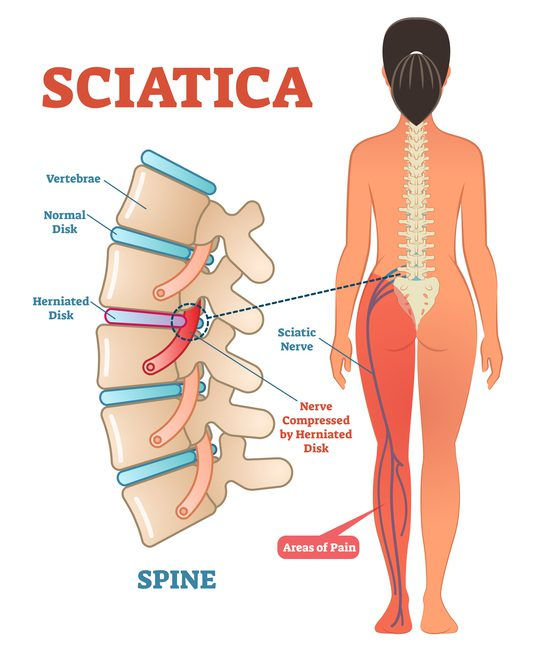
A big concern many of my clients have initially is whether more serious injuries that affect nerves can heal. We're talking about disc herniations and the consequences of a spinal disc impinging on different structures in the body.
My particular injury way back when was an L5 S1 (your very last spinal disc) herniation that resulted in an impingement of the sciatic nerve on my right side. Many of you who have been around long enough know that I've completely healed from this injury and am stressing my spine more than ever, loading over 400lbs on squats and over 500lbs on deadlifts.

But can this be the case for all disc herniations, and is my injury even truly healed? Will I end up paying for it in some way when I'm older?
Let's first address whether and how discs can heal. We understand that if we strain a muscle or break a bone, it can regenerate. But initially, it was believed that the shock-absorbing discs between our vertebrae were unable to adapt in this same way. They were thought of as unadaptable structures that would decline with age, as was verified by many points of data showing the increasing rate of disc bulges and herniations as we age.
Another way to look at this is that we were thought to have a certain "budget" for how much stress we could put on our spine.
Many models viewed our discs as jelly doughnuts that would herniate when enough compressive force is applied to them, causing the aforementioned issues. This model portrays the spine as pretty darn fragile.

Thankfully, this isn't the case.
A 2026 study found that discs are responsive to stress. And if the disc is responsive to stress, "then physical activity, long known to benefit musculoskeletal health, could be reframed not as a risk, but as a critical determinant of spinal resilience." They also argued that "appropriate loading through regular physical activity represents a largely untapped intervention for maintaining and even improving disc health." (148)
You remember the data showing how disc bulge and herniation rates increase with age. But what if the amount a disc is bulging doesn't even matter? An important finding in cooperation with that was that these disc bulges were asymptomatic, meaning zero pain. A great summary post by "Dr. Susie Squats" demonstrates this well.

There's a lot of deeper research to explain why we can have physical impingement of structures with zero pain and no impingement with significant pain present. But from a disc perspective, when a disc herniates, it releases inflammatory chemicals in the area, causing pain and irritation of nerves and surrounding structures, regardless of physical impingement. (149)
This is partly why surgery that removes the impingement doesn't always solve the issue.
What's also fascinating about discs is that the majority of them reabsorb on their own, and the worse it is, the more likely it is to reabsorb. A 2023 study found that the overall resorption incidence for lumbar disc herniations was 70.39%, which usually occurs within 6 months with conservative treatment. (151)
The human body is always trying to heal itself, and discs are no exception. Conservative treatment generally includes activity modification, gentle movement and physical therapy, as well as pain medications and injections if absolutely necessary.
Ultimately, your spine is adaptable to stress and can recover from serious injury. Sometimes you need to address impingement at the spine, and sometimes you need to address the inflammatory reaction happening at the nerve root, but there's always a way forward.
To your good health,
Coach Stephen
References:
https://bjsm.bmj.com/content/60/5/323.abstract - Re-thinking disc loading (2026)
https://pmc.ncbi.nlm.nih.gov/articles/PMC6235196/ - 2018 - Inflammatory response to disc herniation
https://pubmed.ncbi.nlm.nih.gov/37559207/ - Spinal disc resorption rates
Thanks for reading.
P.S.
Whenever you’re ready, here are a few additional ways that I may be able to help you.
Free:
Instagram: @CoachStrumos
*I share tons of bite-sized lessons and tips here
Paid:
1-on-1 Pain Management and Strength Coaching: Apply here


Comments